[What Nasciano did when he arrived, and what Gasquilan and Arquisil said to Amadis.]
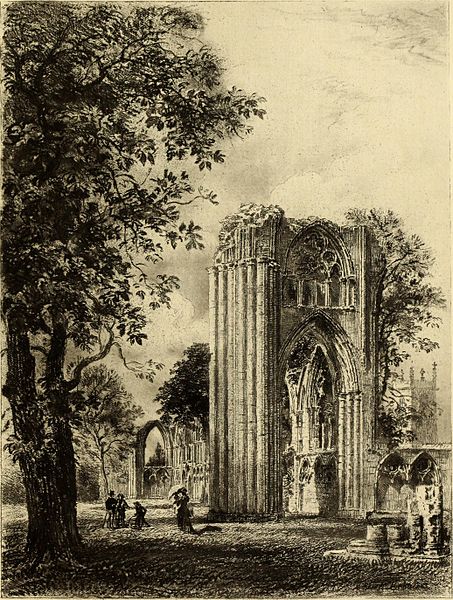
[St. Mary’s Abbey, a Benedictine monastery, from The Ruined Abbeys of Yorkshire by William Lefroy, 1883.]
+
In the meantime the good and holy man Nasciano arrived, which greatly pleased them all, because up until that moment both sides had suffered great discord in all things, and great reversals and fatigues had come to them, but this had been entirely transformed into peace, in which all their spirits took great pleasure in rest and repose. When the good man saw them together in such love when only three days ago they had been killing each other with such cruelty, he raised his hands to the heavens and said:
“Oh Lord of the world, how great is Thy holy pity and the way Thou sendest it over those who have some understanding of Thy holy service. The blood of these kings and knights is not yet dry in the injuries caused them by the Evil Enemy. And because in Thy name and with Thy grace I set them on the right road, and they were willing to understand how great an error they were in, Thou, Lord, hast brought them so much love and goodwill that no one could have imagined it. And so, Lord, may it please Thee to allow this peace to be brought to its conclusion and end, so I as thy servant and a sinner, before I leave them, may give them such serenity that they will set aside the things contrary to Thy service and shall commit themselves to enacting Thy holy Catholic faith.”
This saintly hermit had done nothing other than go from one side to the other, placing before them many examples and doctrines so they might follow them and carry them out as he had brought them, and so their hard hearts could become fully soft and reasonable.
As they were altogether in that chamber one day, King Lisuarte asked King Perion from whom he had learned that the troops were attacking him. King Perion told him how young Esplandian had told it to Amadis, and that he knew nothing more. Then the King had Esplandian called and asked him how he had learned about those troops. He told him how he had been sent by the good man, his foster father, to the King’s encampment, which he found that the King and his men had left, and as he continued on the way, he saw the troops coming down the mountain toward the place where he was going, and he realized how many these men were and how few and in what poor condition the King’s men were, and how they could not defend themselves without great danger. Immediately he and Sarguil had ridden as fast as their palfreys could go all night without stopping, and he told it to Amadis.
King Lisuarte told him:
“Esplandian, ye have done me a great service, and I trust in God that ye shall be well rewarded by me.”
The good man said:
“Son, kiss the hands of your lord the King for what he told you.”
The youth came and knelt and kissed his hands. Then the King took him by the head and pulled him up and kissed him on the face and looked at Amadis. And because Amadis had his eyes fixed on the youth and on what the King was doing, he saw that the King was looking at him, and he blushed because he realized full well that the King knew everything about what had happened between himself and Oriana, and how the youth was his son.
And he was happy at the love the King showed to Esplandian, which touched his heart, and his desire to serve him grew even larger than it had been, and the King felt the same, for the sight and the grace of that young man gave them such contentment that when he was between them, nothing could come that would hinder their affection and love.
Gasquilan, the King of Suesa, had remained in camp, injured from the joust he had fought with Amadis, along with those of his men who had survived the battles. And when King Lisuarte parted from him, he had urged him to leave in a litter and take a right-hand detour on the road as distant from the mountains as he could, and he left men with him who could guide him well. And so they did and brought him to a meadow upon the banks of a river, which lay between him and the mountains.
He lodged there that night beneath some trees, and the next day went on his way, but due to the great distance and the roundabout route he took, he did not reach Lubaina and until five days had passed, and he arrived at the monastery where the kings were, knowing nothing of what had happened. And when they told him about it, he felt very sad to be in such a state that he had not participated in such an extraordinary event, and as he was very haughty and arrogant, with great pride he made some complaints that those who heard them did not consider good.
When King Perion and King Cildadan and those lords learned he had arrived, they went to meet him at the gate of the monastery where he was in his litter and helped him from it, and the knights took him in their arms and put him where King Lisuarte was resting, for he had asked them to do so. And there in the chamber where the King was they made another bed, where they put him.
When Gasquilan was there, he looked at all those knights from Firm Island and saw them so handsome and so well figured and dressed for war, that in his opinion he had never seen men who looked so good. He asked which of them was Amadis, and they pointed him out. And because Amadis learned he had been asked about, he came to him hand-in-hand with King Arban of North Wales, and he said:
“My good lord, may ye be very welcome. I would have been very pleased to find you well rather than how ye are, for in such a good man is yourself, ill health is ill employed. But it shall please God for you to be well soon, and for the disagreement between you and I to be mended with good works.”
Gasquilan, seeing Amadis so handsome and relaxed and courteous, if he had not known his ability so well, both from what he had heard about him and from what he had learned when he tested him, he would not have considered him highly, for he seemed better prepared to be among damsels than among knights and acts of war. And because Gasquilan was valiant in strength and spirit, he thought he should also be so in his speech, because he believed that anyone who was very brave ought to be brave in everything, and if in any way he was lacking, that would greatly diminish his worth. And for that reason he did not consider it a fault to be arrogant. Instead, he thought highly of that, and whether he was fooling himself, anyone can be the judge.
In answer to Amadis he said:
“My good lord Amadis, ye are the knight I most wished to see in the world not for your good nor for mine, instead to fight you to the death. And if what had happened to me from you now had happened to you from me, and if what I received from you ye would have received from me, besides considering myself the most honored knight in the world, I would have received the love of a lady whom I very much love and desire, on whose orders I have been seeking you. Because of what has happened to me, I do not know how I can appear before her. And so my ill health is much greater in what cannot be seen than in what is clear and publicly obvious to all.”
Amadis, when he heard that, he said:
“The matter with your lady-love must give you much sorrow. It does to me, and all that could have been won by defeating me ye should not consider important because your deeds are so great and famous throughout the world and ye are so outstanding in feats at arms, that ye would not have gained much by overcoming a knight of such little fame as myself.”
Then King Cildadan said, laughing, to King Lisuarte:
“My lord, it would be well for you to place your royal staff between these two knights and command them to be at peace.” And for the pleasure of everyone he made other jokes.
And so those Kings and knights remained in the monastery very well provided with everything they needed, and since King Lisuarte was within his own lands, he had many delights brought in such abundance that it gave everyone great contentment. King Perion asked him many times to let him go with his men to Firm Island, and he would immediately send the two knights for the negotiations as they had agreed, but King Lisuarte was never willing to do so. He said that because God had brought him there, in no way did he wish to let him go until everything was settled, and so King Perion was embarrassed to ask him again. Instead he tried to show the same goodwill as King Lisuarte.
Arquisil spoke with Amadis, asking him where he would order him to be in prison, since soon he would have to fulfill the promise he had made. Amadis told him that he would speak to him concerning that and other things that he had been thinking about, and that the next morning after hearing Mass he should have his horse brought, for Amadis wished to speak to him in the countryside. He did so, and the next day they mounted their horses and left to ride outside the town walls. When they were far away from everyone, Amadis told him:
“My good lord, all these past days here I have wished to speak to you, but I have been so busy I have not been able to do so. Now that we have time I wish to tell you my thoughts regarding yourself. Since the Emperor of Rome is dead, as he is, I know that because ye are in direct lineage by blood, there is no one else in the Empire with the right to succession or inheritance besides you. I also know that among all those who are lords there, ye are well loved. And if anyone does not love you, it is only because your kinsman, the Emperor, envied your good conduct, and his bad attitude gave them a reason to dislike you.
“Since the matter has reached this point, it would be very reasonable to take care of something as important as this is. Ye have here most of the best knights in the kingdom of Rome, and I have at Firm Island Brondajel de Roca, the Duke of Ancona, the Archbishop of Talancia, and many others who were taken prisoner at sea. I will immediately send for them and speak to them about it, and before they arrive here arrangements should be made for them to swear loyalty to you as their Emperor.
“And if some of them are contrary, I shall help you achieve all your rights. So, my good friend, think about that, work to make it happen, and recognize the opportunity God gives you, and do not lose it through your own fault.”
When Arquisil heard this, ye can well imagine the pleasure it gave him, for he had only expected to be sent to a prison somewhere that he would not be able to leave for a long time. He told him:
“My good lord, I do not know why everyone in the world does not seek your love and recognition and to increase your honor and estate. And as for myself, I see that whether or not what ye say can be accomplished, whatever fate may bring, there will never be a time in which I shall not repay the great gifts and honor that I have received from you, even to the point of giving up my life. If thanks could be enough for the great benefit ye have given me, I would give them. But what could these thanks be? Truly none other thanks than my own person, as I have said, with all that God and my blessings would permit me to give. Starting now I place in your hands all my welfare and honor. And since ye have spoken so clearly, it shall be carried out as a victory more for you than for me.”
“Then I shall take charge of it,” Amadis said, “and with the help of God ye shall leave here as Emperor or I shall not consider myself a knight.”
And so they finished that discussion, and Amadis said:
“Before we return to the monastery, let us enter the town, where I will show you the man who wishes the worst for me in the world.”
And so they entered Lubaina and went to the lodgings of Sir Gandales, where he was holding prisoner King Arabigo and Arcalaus and the other knights that ye have heard about. When they arrived there, they went directly to the chamber where King Arabigo and Arcalaus were alone, and they found them dressed and sitting on a bed, for since they had been taken prisoner, they had not wished to remove their clothing. Amadis immediately recognized Arcalaus and told him:
“What are ye doing, Arcalaus?”
And he said:
“Who art thou to ask?”
“I am Amadis of Gaul, he whom thou so much wished to see.”
Then Arcalaus looked at him more carefully and said:
“Truly, thou speakest the truth, and although it has been a long time since I have seen thee, I have not forgotten to recognize that I had thee, Amadis, in my power in my castle at Valderin. And I had pity for thy youth and thy handsome looks, but since then for a long time thou hast placed me in many great tribulations until in the end I have reached such straits that now I must ask thee for mercy.”
Amadis told him:
“And if I had it for thee, wouldst thou cease to do the great evil and cruelty that thou hast committed until now?”
“No,” he said, “I have been accustomed to it for so long that I could not will myself to change those vices. But necessity, which is a very forceful and strong means for changing every bad habit to good or good to bad according to each person and situation, would make me do in my old age what in my youth and freedom I did not wish to do nor could.”
“Then, what necessity could I placed upon thee,” Amadis said, “if I were to release thee and give thee freedom?”
“The necessity of that,” Arcalaus said, “which by having and increasing has done great harm to my conscience and fame, which are my castles. I shall order them given and delivered to thee with all my land, and I shall not take from it more than what thou mayst wish to give me according to thy virtue, because at the present I have no other thing to give. And it may be that such great need and thy great goodness shall cause a change in what up until now reason has not had any luck in bringing about.”
Amadis told him:
“Arcalaus, if I had any hope that thy deep-rooted condition could be corrected, it is in nothing other than the knowledge of thy recognition that thou knowest thyself to be evil and sinful. For that reason, take strength and consolation, for it may be that the prison where thou art now and hast so much feared shall be the key to release thy soul, which for so long thou has held enchained and imprisoned.”
And as Amadis was about to leave, Arcalaus told him:
“Amadis, see this unfortunate knight who until recently was one of the greatest princes in the world. At one time fortune itself was favorable for him, but now it has brought him down and put him in such cruel captivity. May he be an example to thee and all those who have wished for honor and high estate. I would remind thee that strong spirits and hearts are the basis for conquest and pardon.”
Amadis did not wish to respond, since he held him as a prisoner, but he considered saying that Arcalaus had defeated many men by weapons and enchantments, but he never learned to pardon a single one. And yet Amadis could not help but realize that Arcalaus had made a strong argument.
+
Showing posts with label Arcalaus. Show all posts
Monday, September 19, 2016
Tuesday, April 19, 2016
Chapter 108
How, when Arcalaus the Sorcerer knew the armies were preparing to fight, as fast as possible he sent for King Arabigo and his men.
[Fourteenth-century illustration of the third Battle of Homs, 1299, in Fleur des Histoires d'Orient by Hayton of Corycus.]
+
Arcalaus the Sorcerer had alerted King Arabigo and Barsinan, lord of Sansuena, and the King of Deep Island, who had escaped from the Battle of the Seven Kings, and all the relatives of Dardan the Arrogant. And when he learned that troops were joining the men of King Lisuarte and Amadis, he hastily sent a knight from his family named Garin, son of Grumen, whom Amadis had killed when Grumen, three other knights, and Arcalaus the Sorcerer kidnaped Oriana, as the first book of this story recounts. And he ordered Garin not to rest day or night until he had notified all those kings and knights and told them to come in a hurry. He remained in his castles calling on his friends and members of Dardan’s lineage, gathering as many men as he could.
Garin reached King Arabigo, finding him in his great city named Arabiga, the capital of his entire kingdom, which from its name all the kings there called themselves Arabigo because their reign included a great part of the land of Arabia. He told him everything Arcalaus wanted him to know, and all the others who had their men on alert, and when they learned this news, immediately and without delay they called up the troops, and they all came, one after another, and they met near a very fine town in the domain of Sansuena named Califan. They set up their tents in the fields and numbered almost 12,000 knights. And there they brought together all their fleet, which was astonishingly big and with fine sailors, and loaded it with all of the provisions that they could get, for they were going to a foreign kingdom. And with great pleasure and favorable weather they went out to sea and in eight days arrived at a port in Great Britain in a place where Arcalaus had a mighty castle with the seaport.
Arcalaus had with him 600 very fine knights, most of them fugitives who despised King Lisuarte and Amadis because they had pursued and killed many of their relatives who were wrongdoers.
When that fleet arrived at port, it cannot be told to you the great pleasure that they had with each other, and as they knew from Arcalaus’s spies that the armies of King Lisuarte and Amadis were already marching toward each other, and the roads they were taking, they immediately moved out with all their men. In the lead was Barsinan, a young and hardy knight very eager to avenge the deaths of his father and his brother Gandalot and show the burning strength of his heart, with 2,000 knights and some archers and crossbow men.
Arcalaus led the second column, and ye may believe that in courage and valor he was no less than Barsinan; indeed, although he had lost half his right hand, a better or more valiant knight at arms than him would be hard to find in many lands, except that his dark arts and lies erased all the praise that his courage had won. He led 600 knights, and King Arabigo gave him 2,400 of his men.
The third column was taken by King Arabigo and by the King of Deep Island with all the remaining men, and they brought with them six knights from the family of Brontaxar d’Anfania, whom Amadis had killed in the Battle of the Seven Kings when he wore a golden helmet, as the third book of the story recounts. Brontaxar d’Anfania had been as valiant as his body was strong, and the seven Kings had hoped to win with his help, and truly, they would have if Amadis had not seen the great damage Brontaxar was doing to King Lisuarte’s men, which, if the battle would have lasted long, would have been enough to give the honor of victory to the side of the seven Kings. So Amadis went for him and with a single blow cut him down, and he fell to the ground, where he died.
The six knights of whom I am speaking came from Centaur Island, where it is said that the centaurs had their first home, and they were as grand in body and strength as them, for they were the direct descendants of the greatest and bravest giants that the world ever had. When they learned that this great battle was being arranged, they wished to be in it so they could avenge Brontaxar’s death, who was the foremost man of their lineage, and to test themselves against those knights whose great fame they had heard of. And for this reason they came to King Arabigo, who was very pleased with them and urged them to join his battalion, which they did against their will because they would have preferred to be sent to the vanguard.
And in the meantime there arrived the Duke of Bristol, who, although he had been summoned by Arcalaus, had not ventured to show himself, believing that what Arcalaus had told him was of slight importance, but when he saw how many men had come together there, he considered it to his advantage to join them because he might be able to avenge the death of his father, who was killed by Sir Galvanes and Agrajes with Olivas, as the first book of the story recounts, and to recover the land that King Lisuarte had taken from him, claiming that his father had died as a traitor. He believed that if the battle went badly for King Lisuarte, he would be able to get his land restored, and if it went badly for Amadis, he could take revenge on those who had done him so much harm.
And when he arrived and King Arabigo and all the other lords saw him and were told who he was, they were very pleased with him, and his arrival gave them courage because they considered him and the men he brought more important, because he was a native of those lands and had some towns and castles in it, than someone who was a foreigner but who brought many more men. The Duke and his men and 500 knights that King Arabigo gave him were made reserve troops.
And with the army arranged in columns as ye hear, they left down a side road, setting the best guards they could, and agreeing to locate themselves in a place where they would be safe and from which they could attack when it was time to strike their enemies.
+
[Fourteenth-century illustration of the third Battle of Homs, 1299, in Fleur des Histoires d'Orient by Hayton of Corycus.]
+
Arcalaus the Sorcerer had alerted King Arabigo and Barsinan, lord of Sansuena, and the King of Deep Island, who had escaped from the Battle of the Seven Kings, and all the relatives of Dardan the Arrogant. And when he learned that troops were joining the men of King Lisuarte and Amadis, he hastily sent a knight from his family named Garin, son of Grumen, whom Amadis had killed when Grumen, three other knights, and Arcalaus the Sorcerer kidnaped Oriana, as the first book of this story recounts. And he ordered Garin not to rest day or night until he had notified all those kings and knights and told them to come in a hurry. He remained in his castles calling on his friends and members of Dardan’s lineage, gathering as many men as he could.
Garin reached King Arabigo, finding him in his great city named Arabiga, the capital of his entire kingdom, which from its name all the kings there called themselves Arabigo because their reign included a great part of the land of Arabia. He told him everything Arcalaus wanted him to know, and all the others who had their men on alert, and when they learned this news, immediately and without delay they called up the troops, and they all came, one after another, and they met near a very fine town in the domain of Sansuena named Califan. They set up their tents in the fields and numbered almost 12,000 knights. And there they brought together all their fleet, which was astonishingly big and with fine sailors, and loaded it with all of the provisions that they could get, for they were going to a foreign kingdom. And with great pleasure and favorable weather they went out to sea and in eight days arrived at a port in Great Britain in a place where Arcalaus had a mighty castle with the seaport.
Arcalaus had with him 600 very fine knights, most of them fugitives who despised King Lisuarte and Amadis because they had pursued and killed many of their relatives who were wrongdoers.
When that fleet arrived at port, it cannot be told to you the great pleasure that they had with each other, and as they knew from Arcalaus’s spies that the armies of King Lisuarte and Amadis were already marching toward each other, and the roads they were taking, they immediately moved out with all their men. In the lead was Barsinan, a young and hardy knight very eager to avenge the deaths of his father and his brother Gandalot and show the burning strength of his heart, with 2,000 knights and some archers and crossbow men.
Arcalaus led the second column, and ye may believe that in courage and valor he was no less than Barsinan; indeed, although he had lost half his right hand, a better or more valiant knight at arms than him would be hard to find in many lands, except that his dark arts and lies erased all the praise that his courage had won. He led 600 knights, and King Arabigo gave him 2,400 of his men.
The third column was taken by King Arabigo and by the King of Deep Island with all the remaining men, and they brought with them six knights from the family of Brontaxar d’Anfania, whom Amadis had killed in the Battle of the Seven Kings when he wore a golden helmet, as the third book of the story recounts. Brontaxar d’Anfania had been as valiant as his body was strong, and the seven Kings had hoped to win with his help, and truly, they would have if Amadis had not seen the great damage Brontaxar was doing to King Lisuarte’s men, which, if the battle would have lasted long, would have been enough to give the honor of victory to the side of the seven Kings. So Amadis went for him and with a single blow cut him down, and he fell to the ground, where he died.
The six knights of whom I am speaking came from Centaur Island, where it is said that the centaurs had their first home, and they were as grand in body and strength as them, for they were the direct descendants of the greatest and bravest giants that the world ever had. When they learned that this great battle was being arranged, they wished to be in it so they could avenge Brontaxar’s death, who was the foremost man of their lineage, and to test themselves against those knights whose great fame they had heard of. And for this reason they came to King Arabigo, who was very pleased with them and urged them to join his battalion, which they did against their will because they would have preferred to be sent to the vanguard.
And in the meantime there arrived the Duke of Bristol, who, although he had been summoned by Arcalaus, had not ventured to show himself, believing that what Arcalaus had told him was of slight importance, but when he saw how many men had come together there, he considered it to his advantage to join them because he might be able to avenge the death of his father, who was killed by Sir Galvanes and Agrajes with Olivas, as the first book of the story recounts, and to recover the land that King Lisuarte had taken from him, claiming that his father had died as a traitor. He believed that if the battle went badly for King Lisuarte, he would be able to get his land restored, and if it went badly for Amadis, he could take revenge on those who had done him so much harm.
And when he arrived and King Arabigo and all the other lords saw him and were told who he was, they were very pleased with him, and his arrival gave them courage because they considered him and the men he brought more important, because he was a native of those lands and had some towns and castles in it, than someone who was a foreigner but who brought many more men. The Duke and his men and 500 knights that King Arabigo gave him were made reserve troops.
And with the army arranged in columns as ye hear, they left down a side road, setting the best guards they could, and agreeing to locate themselves in a place where they would be safe and from which they could attack when it was time to strike their enemies.
+
Tuesday, December 22, 2015
Chapter 96
How King Lisuarte asked for advice from King Arban of North Wales, Sir Grumedan, and Guilan the Pensive, and what their answer was.
[Detail of the Serrano Towers, a gateway in the city walls of Valencia, completed in 1398. Photo by Sue Burke.]
+
After the knights left King Lisuarte, he had King Arban of North Wales, Sir Grumedan, and Guilan the Pensive called, and he told them:
“My friends, ye know the position that I am put in by the knights of Firm Island, and the great dishonor I have received from them, and if I do not respond in a way that will break their great pride, I would not consider myself a king nor do I think anyone else would. In order to give an accounting of myself the way that prudent men ought to do, which is to act after receiving a great deal of advice and deliberating carefully, I wish ye to tell me how things seem to you, as I have asked, so that I may make a decision that will serve my best interests.”
King Arban, who was a good and very prudent knight and who had a deep desire to honor the King, told him:
“My lord, these knights and I have thought very deeply and have spoken together, as ye ordered us, so that we can give you the best advice that our judgment can supply. We have found that since your will is not to reach any agreement with those knights, everything necessary must be sought with great diligence and discretion so that they may be brought to order and their madness contained. My lord, on one hand we see that the knights at Firm Island are numerous and very mighty in arms, as ye know, for by the grace of God they spent a long time in your service. And in addition to their abilities and resources, we have been assured that they have sent messengers to many places seeking help, which we believe they will find, because they are of great lineages, sons and brothers of kings and other great men, and because they have won a large number of friends. And when men arrive from many different places, soon they will constitute a great horde.
“And on the other hand, my lord, we have seen that your house and court has lost very many knights, more than at any other time in our memory. And the greatness of your estate has caused you to have many enemies who will now show the ill will that they hold against you, since many grievances of this kind are more often revealed in times of need, while during good times they are maintained in silence.
“So for these reasons as well as for many others that we could tell you, it would be good if your vassals and friends would be called upon to learn what they can offer, especially the Emperor of Rome, who has more at stake in this than you, as the Queen has told you. And once it is known how much strength ye can have, my lord, then ye may take vigorous action or whatever other course available to you.”
The King considered this good advice, and said that it was what he wished to do. And he ordered Sir Guilan to take charge of being the messenger to the Emperor, since such a knight as himself would be fitting for such a mission. He answered:
“My Lord, I am ready to serve you in this and in a great deal more. And may God be pleased in His mercy that this will result in an increase in your honor and estate, just as I myself wish for you, and may I be dispatched soon, so that your order will be carried out quickly.”
The King said:
“Ye will only need a letter of credentials, which is here, and ye should say to the Emperor that as he chose to send Salustanquidio and Brondajel de Roca, his senior majordomo, and a great many other knights to ask for my daughter Oriana so he could wed her, and as I decided to make him happy and to have him in my family, against the will of all my subjects who wanted to have her as their lady at the end of my days, I arranged to have her sent to him, although with great pity from me and with much sorrow and anguish from her mother to see her leave us to go to such foreign lands. When she was taken by his men with her ladies and damsels, and they were sailing in the sea beyond the limits of my kingdom, Amadis of Gaul and other knights who were his friends departed in another fleet from Firm Island and, after all the Emperor’s men were defeated and Salustanquidio killed, my daughter and all those who were still alive were taken by them to that island, where they hold her.
“They have sent messengers to me by whom they offered me some agreements, but, knowing that he more than I is involved in this matter, I did not wish to enter into any agreement with them until I informed him. He should know that what would make me most satisfied would be if we were to besiege them where they hold her and that a way we could show the entire world that we consider them thieves and robbers, and we as great princes shall punish them for their great insult to us. And ye should tell him whatever else ye think best in this case, and if he is in agreement, may it be immediately placed in execution, because injuries always grow when the solution to them is delayed.”
Sir Guilan told him:
“Everything shall be done as ye order, and may it please God if my voyage has the same effect as my will to serve you.” And taking a letter of credentials, he left for the sea, and this story shall recount what he did farther on.
When that was done, the King had Brandoivas called and ordered him to go to the island of Mongaza to see Sir Galvanes and tell him to come immediately with all the men on the island. And from there he should go to Ireland to see King Cildadan and give him the same message, and to work with him to come as best prepared for war as he could be to wherever Lisuarte was. In the same way he ordered Filispindel to go to Gasquilan, King of Suesa, and to tell him what was happening, for, as he was such a famous knight who was always in search of great deeds, now he would have the opportunity to demonstrate his virtue and the courage that burned in his heart.
And in the same way he sent many others of his friends, allies, and vassals, and called for his entire kingdom to be prepared by the time that those messengers returned. And he gave orders to look for as many horses and weapons as could be found in all parts so he would have as many mounted men as possible.
But now we shall leave this, and no more shall be said until its proper time, to tell what Arcalaus the Sorcerer did.
The story recounts that as Arcalaus the Sorcerer was in his castles, always hoping to cause some harm as he and all evil man are accustomed to do, news arrived to him about the discord and disruption between King Lisuarte and Amadis. The great pleasure he took from that need not be told, because those were the two men in the world whom he most despised, and his thoughts and concerns never ceased devising how he might cause their destruction.
He considered what he might do in this situation to cause them the greatest harm, since in his heart he could not find it to help either one of them. And as he was subtle in everything vile, he decided to try to bring together a third army made up of the enemies of both King Lisuarte and Amadis and to locate it in such a way that if there were a battle, the men on his own side could very easily defeat and destroy those who remained.
With this thought and desire, he mounted his horse, brought with him all the servants he would need, and traveled both by land and sea to King Aravigo, who had been left so badly injured after the battle that he and his companions, the other six kings, fought against King Lisuarte, as the third part of this story has recounted, and who had received such harm and dishonor in the battle from Amadis and his family. When he arrived, he said:
“Oh King Aravigo, since thou hast the great spirit and courage that the grandeur of thy royal estate requires and the great discretion thou must have to govern it, contrary fortune, which in the past has been such an enemy to thee, now has repented and wishes to make amends so that the great discredit to thy honor may be satisfied by a double victory, which if thou art wise, thou shalt realize is in thy hand. And thou, King, should know that I was in my castles thinking carefully about thy loss and how to find a way to repair it, because as thy servant the enhancement of thy royal estate would bring me great advantage; then I learned very trustworthy news that the great enemies of thee and me, King Lisuarte and Amadis of Gaul, have confronted each other over a cause of such magnitude that by no means is amends expected nor possible except by a great battle and combat that will cause the destruction of one of them, or by good fortune, of both. And if thou wishest to take my advice, it is certain that not only will the loss that thou suffered in the past with me be regained but thy estate will be increased by many more reigns, and afterwards all of us will be in thy service.”
After King Aravigo heard this and considered how Aracalaus had arrived from such distant lands with such haste, he said:
“My friend Arcalaus, the length of your journey and the fatigue it must have caused you give me reason to consider your arrival very important and to believe everything that ye have told me. I would like what ye have said to be recounted more extensively because my intention will always be to pursue whatever will serve my grandeur, even in adverse times.”
Arcalaus told him:
“As thou knowest, King, the Emperor of Rome wished to take a wife, and asked King Lisuarte to give him his daughter Oriana. Although the Princess was the rightful heir of Great Britain, Lisuarte, considering the Emperor’s grandeur, decided to give her to him and delivered her to a first cousin of the Emperor himself named Salustanquidio, a very powerful prince. He was with her and a large company of Romans traveling by sea when Amadis of Gaul and many knights who were his friends attacked them. After this prince was killed and his fleet was destroyed, and many of those in it taken prisoner or killed, Oriana was stolen and carried to Firm Island, where they hold her. Thou canst imagine the discredit that this brings to King Lisuarte and the Emperor.
“I wish thee to know that this Amadis of whom I speak was one of the knights who wore the armor with the insignia of serpents and who fought against thee and the other six kings in the great battle thou hadst with King Lisuarte. He was the one who wore the golden helmet, and due to his great deeds and courage, victory was snatched from thy hands. And, as a result of what I have described, King Lisuarte on one side and Amadis on the other are calling together all the men they can, so it can and must rightly be believed that the Emperor himself will come in person to avenge the great sorrow in his heart and his loss of honor. And thou canst conclude what harm could occur to them if there is a battle.
“If thou wouldst call up thy men, I shall provide the help of Barsinan, Lord of Sansuena, son of the other Barsinan whom King Lisuarte killed in London, and I can also give thee the entire lineage of the good knight Dardan the Arrogant, whom Amadis killed at Windsor, which would be a large company of very good knights. And I can also call upon the King of Deep Island, who escaped from the battle with thee.
“With all these men, we could place ourselves where, under my guidance, when the battle is over, thou canst have at thy mercy both the victors and the losers without any danger to thy men. Then, what could result from this other than by winning such a great victory that all of Great Britain would be subject to thee, and thy royal estates would be placed at a higher pinnacle than any other emperor in the world? Now, mighty King, consider whether for a little effort and danger, thou wishest to win such great glory and realms.”
When King Aravigo heard this, he was very happy, and he said:
“My friend Arcalaus, what a great thing ye have told me, and although my desire is not to tempt fate further, it would be madness to set aside things that very rightly offer great honor and advantage, because if the results are as hoped and reason itself is a guide, men receive the fruit that their efforts deserve. And if the result is to the contrary, they must still do that which they are obliged to by virtue, in consideration of the honors it could give them and disregarding their previous misfortune. When the opportunity offers itself, they must not fail to take it, for otherwise they would be subjected, defeated, and dishonored for all the days of their lives. Given that, do not worry about what concerns me and my men and friends, but in the other matters proceed with the urgency and diligence that ye see as appropriate for such a situation.”
Arcalaus, with this promise from the King, left for Sansuena and spoke with Barsinan, reminding him of the death of his father and his brother Gandalod, whom Sir Guilan the Pensive had defeated and taken prisoner for King Lisuarte, who in turn ordered him to be thrown from a tower where his father had been burned at its foot. He also told him how at that time he had arranged for his father to be king of Great Britain and had taken King Lisuarte and his daughter prisoner, and how because of Amadis, everything had been lost. But now Barsinan had a chance not only to avenge his enemies as he wished, but that the great realm that his father had failed to take, he himself would be able to acquire, and he should be brave because otherwise great things can rarely be obtained. For if fortune had been contrary to his father, it had repented and wish to give him satisfaction for the injuries he had received. And he told him how King Aravigo was preparing everything in his power because he saw the issue so certain of victory that there was no way to err, with all the other help that was certain to arrive, among many other reasons.
Such were the arts that Arcalaus had always practiced as a great master of dark deeds.
Because Barsinan was a very proud young man, and resembled his father in wickedness, with little difficulty an effort Arcalaus achieved everything he wished. With a burning heart and excessive arrogance Barsinan responded that with full urgency and intention he would undertake that labor, bringing with him all of the men of his realm, and from beyond it all those who wish to follow him. When Arcalaus heard that answer, he was very happy at how he had made preparations that fulfilled his will, and he told him to immediately make everything ready for when he sent for them, because it was very important for this to be attended with diligence.
And from there he quickly traveled with a very happy heart to the King of Deep Island, and spoke with him for a long time. And because of all the things he said and all his arguments, just as with the others, he convinced him to call up his men and get them in order and prepared for when they would be needed.
When this was done, he returned to his own lands and spoke with the family of Dardan the Arrogant using the same arguments, and because of that, they all believed they could obtain great advantage. As secretly as he could he made agreements with them, telling them of the great preparations he had made. And so he waited for the time to put in play everything that ye have heard.
But now the story shall not speak of this until its proper time, and it shall turn to tell what happened to Sir Cuadragante and Sir Brian of Monjaste after they left the court of King Lisuarte.
+
[Detail of the Serrano Towers, a gateway in the city walls of Valencia, completed in 1398. Photo by Sue Burke.]
+
After the knights left King Lisuarte, he had King Arban of North Wales, Sir Grumedan, and Guilan the Pensive called, and he told them:
“My friends, ye know the position that I am put in by the knights of Firm Island, and the great dishonor I have received from them, and if I do not respond in a way that will break their great pride, I would not consider myself a king nor do I think anyone else would. In order to give an accounting of myself the way that prudent men ought to do, which is to act after receiving a great deal of advice and deliberating carefully, I wish ye to tell me how things seem to you, as I have asked, so that I may make a decision that will serve my best interests.”
King Arban, who was a good and very prudent knight and who had a deep desire to honor the King, told him:
“My lord, these knights and I have thought very deeply and have spoken together, as ye ordered us, so that we can give you the best advice that our judgment can supply. We have found that since your will is not to reach any agreement with those knights, everything necessary must be sought with great diligence and discretion so that they may be brought to order and their madness contained. My lord, on one hand we see that the knights at Firm Island are numerous and very mighty in arms, as ye know, for by the grace of God they spent a long time in your service. And in addition to their abilities and resources, we have been assured that they have sent messengers to many places seeking help, which we believe they will find, because they are of great lineages, sons and brothers of kings and other great men, and because they have won a large number of friends. And when men arrive from many different places, soon they will constitute a great horde.
“And on the other hand, my lord, we have seen that your house and court has lost very many knights, more than at any other time in our memory. And the greatness of your estate has caused you to have many enemies who will now show the ill will that they hold against you, since many grievances of this kind are more often revealed in times of need, while during good times they are maintained in silence.
“So for these reasons as well as for many others that we could tell you, it would be good if your vassals and friends would be called upon to learn what they can offer, especially the Emperor of Rome, who has more at stake in this than you, as the Queen has told you. And once it is known how much strength ye can have, my lord, then ye may take vigorous action or whatever other course available to you.”
The King considered this good advice, and said that it was what he wished to do. And he ordered Sir Guilan to take charge of being the messenger to the Emperor, since such a knight as himself would be fitting for such a mission. He answered:
“My Lord, I am ready to serve you in this and in a great deal more. And may God be pleased in His mercy that this will result in an increase in your honor and estate, just as I myself wish for you, and may I be dispatched soon, so that your order will be carried out quickly.”
The King said:
“Ye will only need a letter of credentials, which is here, and ye should say to the Emperor that as he chose to send Salustanquidio and Brondajel de Roca, his senior majordomo, and a great many other knights to ask for my daughter Oriana so he could wed her, and as I decided to make him happy and to have him in my family, against the will of all my subjects who wanted to have her as their lady at the end of my days, I arranged to have her sent to him, although with great pity from me and with much sorrow and anguish from her mother to see her leave us to go to such foreign lands. When she was taken by his men with her ladies and damsels, and they were sailing in the sea beyond the limits of my kingdom, Amadis of Gaul and other knights who were his friends departed in another fleet from Firm Island and, after all the Emperor’s men were defeated and Salustanquidio killed, my daughter and all those who were still alive were taken by them to that island, where they hold her.
“They have sent messengers to me by whom they offered me some agreements, but, knowing that he more than I is involved in this matter, I did not wish to enter into any agreement with them until I informed him. He should know that what would make me most satisfied would be if we were to besiege them where they hold her and that a way we could show the entire world that we consider them thieves and robbers, and we as great princes shall punish them for their great insult to us. And ye should tell him whatever else ye think best in this case, and if he is in agreement, may it be immediately placed in execution, because injuries always grow when the solution to them is delayed.”
Sir Guilan told him:
“Everything shall be done as ye order, and may it please God if my voyage has the same effect as my will to serve you.” And taking a letter of credentials, he left for the sea, and this story shall recount what he did farther on.
When that was done, the King had Brandoivas called and ordered him to go to the island of Mongaza to see Sir Galvanes and tell him to come immediately with all the men on the island. And from there he should go to Ireland to see King Cildadan and give him the same message, and to work with him to come as best prepared for war as he could be to wherever Lisuarte was. In the same way he ordered Filispindel to go to Gasquilan, King of Suesa, and to tell him what was happening, for, as he was such a famous knight who was always in search of great deeds, now he would have the opportunity to demonstrate his virtue and the courage that burned in his heart.
And in the same way he sent many others of his friends, allies, and vassals, and called for his entire kingdom to be prepared by the time that those messengers returned. And he gave orders to look for as many horses and weapons as could be found in all parts so he would have as many mounted men as possible.
But now we shall leave this, and no more shall be said until its proper time, to tell what Arcalaus the Sorcerer did.
The story recounts that as Arcalaus the Sorcerer was in his castles, always hoping to cause some harm as he and all evil man are accustomed to do, news arrived to him about the discord and disruption between King Lisuarte and Amadis. The great pleasure he took from that need not be told, because those were the two men in the world whom he most despised, and his thoughts and concerns never ceased devising how he might cause their destruction.
He considered what he might do in this situation to cause them the greatest harm, since in his heart he could not find it to help either one of them. And as he was subtle in everything vile, he decided to try to bring together a third army made up of the enemies of both King Lisuarte and Amadis and to locate it in such a way that if there were a battle, the men on his own side could very easily defeat and destroy those who remained.
With this thought and desire, he mounted his horse, brought with him all the servants he would need, and traveled both by land and sea to King Aravigo, who had been left so badly injured after the battle that he and his companions, the other six kings, fought against King Lisuarte, as the third part of this story has recounted, and who had received such harm and dishonor in the battle from Amadis and his family. When he arrived, he said:
“Oh King Aravigo, since thou hast the great spirit and courage that the grandeur of thy royal estate requires and the great discretion thou must have to govern it, contrary fortune, which in the past has been such an enemy to thee, now has repented and wishes to make amends so that the great discredit to thy honor may be satisfied by a double victory, which if thou art wise, thou shalt realize is in thy hand. And thou, King, should know that I was in my castles thinking carefully about thy loss and how to find a way to repair it, because as thy servant the enhancement of thy royal estate would bring me great advantage; then I learned very trustworthy news that the great enemies of thee and me, King Lisuarte and Amadis of Gaul, have confronted each other over a cause of such magnitude that by no means is amends expected nor possible except by a great battle and combat that will cause the destruction of one of them, or by good fortune, of both. And if thou wishest to take my advice, it is certain that not only will the loss that thou suffered in the past with me be regained but thy estate will be increased by many more reigns, and afterwards all of us will be in thy service.”
After King Aravigo heard this and considered how Aracalaus had arrived from such distant lands with such haste, he said:
“My friend Arcalaus, the length of your journey and the fatigue it must have caused you give me reason to consider your arrival very important and to believe everything that ye have told me. I would like what ye have said to be recounted more extensively because my intention will always be to pursue whatever will serve my grandeur, even in adverse times.”
Arcalaus told him:
“As thou knowest, King, the Emperor of Rome wished to take a wife, and asked King Lisuarte to give him his daughter Oriana. Although the Princess was the rightful heir of Great Britain, Lisuarte, considering the Emperor’s grandeur, decided to give her to him and delivered her to a first cousin of the Emperor himself named Salustanquidio, a very powerful prince. He was with her and a large company of Romans traveling by sea when Amadis of Gaul and many knights who were his friends attacked them. After this prince was killed and his fleet was destroyed, and many of those in it taken prisoner or killed, Oriana was stolen and carried to Firm Island, where they hold her. Thou canst imagine the discredit that this brings to King Lisuarte and the Emperor.
“I wish thee to know that this Amadis of whom I speak was one of the knights who wore the armor with the insignia of serpents and who fought against thee and the other six kings in the great battle thou hadst with King Lisuarte. He was the one who wore the golden helmet, and due to his great deeds and courage, victory was snatched from thy hands. And, as a result of what I have described, King Lisuarte on one side and Amadis on the other are calling together all the men they can, so it can and must rightly be believed that the Emperor himself will come in person to avenge the great sorrow in his heart and his loss of honor. And thou canst conclude what harm could occur to them if there is a battle.
“If thou wouldst call up thy men, I shall provide the help of Barsinan, Lord of Sansuena, son of the other Barsinan whom King Lisuarte killed in London, and I can also give thee the entire lineage of the good knight Dardan the Arrogant, whom Amadis killed at Windsor, which would be a large company of very good knights. And I can also call upon the King of Deep Island, who escaped from the battle with thee.
“With all these men, we could place ourselves where, under my guidance, when the battle is over, thou canst have at thy mercy both the victors and the losers without any danger to thy men. Then, what could result from this other than by winning such a great victory that all of Great Britain would be subject to thee, and thy royal estates would be placed at a higher pinnacle than any other emperor in the world? Now, mighty King, consider whether for a little effort and danger, thou wishest to win such great glory and realms.”
When King Aravigo heard this, he was very happy, and he said:
“My friend Arcalaus, what a great thing ye have told me, and although my desire is not to tempt fate further, it would be madness to set aside things that very rightly offer great honor and advantage, because if the results are as hoped and reason itself is a guide, men receive the fruit that their efforts deserve. And if the result is to the contrary, they must still do that which they are obliged to by virtue, in consideration of the honors it could give them and disregarding their previous misfortune. When the opportunity offers itself, they must not fail to take it, for otherwise they would be subjected, defeated, and dishonored for all the days of their lives. Given that, do not worry about what concerns me and my men and friends, but in the other matters proceed with the urgency and diligence that ye see as appropriate for such a situation.”
Arcalaus, with this promise from the King, left for Sansuena and spoke with Barsinan, reminding him of the death of his father and his brother Gandalod, whom Sir Guilan the Pensive had defeated and taken prisoner for King Lisuarte, who in turn ordered him to be thrown from a tower where his father had been burned at its foot. He also told him how at that time he had arranged for his father to be king of Great Britain and had taken King Lisuarte and his daughter prisoner, and how because of Amadis, everything had been lost. But now Barsinan had a chance not only to avenge his enemies as he wished, but that the great realm that his father had failed to take, he himself would be able to acquire, and he should be brave because otherwise great things can rarely be obtained. For if fortune had been contrary to his father, it had repented and wish to give him satisfaction for the injuries he had received. And he told him how King Aravigo was preparing everything in his power because he saw the issue so certain of victory that there was no way to err, with all the other help that was certain to arrive, among many other reasons.
Such were the arts that Arcalaus had always practiced as a great master of dark deeds.
Because Barsinan was a very proud young man, and resembled his father in wickedness, with little difficulty an effort Arcalaus achieved everything he wished. With a burning heart and excessive arrogance Barsinan responded that with full urgency and intention he would undertake that labor, bringing with him all of the men of his realm, and from beyond it all those who wish to follow him. When Arcalaus heard that answer, he was very happy at how he had made preparations that fulfilled his will, and he told him to immediately make everything ready for when he sent for them, because it was very important for this to be attended with diligence.
And from there he quickly traveled with a very happy heart to the King of Deep Island, and spoke with him for a long time. And because of all the things he said and all his arguments, just as with the others, he convinced him to call up his men and get them in order and prepared for when they would be needed.
When this was done, he returned to his own lands and spoke with the family of Dardan the Arrogant using the same arguments, and because of that, they all believed they could obtain great advantage. As secretly as he could he made agreements with them, telling them of the great preparations he had made. And so he waited for the time to put in play everything that ye have heard.
But now the story shall not speak of this until its proper time, and it shall turn to tell what happened to Sir Cuadragante and Sir Brian of Monjaste after they left the court of King Lisuarte.
+
Location:
Madrid, Madrid, Spain
Tuesday, April 15, 2014
Chapter 69 [part 3 of 4]
[How Galaor and Norandel met Dinarda and her damsel, and how they fell in and out of love.]
[Illustration from Roman de la Rose, written by Guillaume de Lorris in the 1200s and made into a manuscript for Count Engelbert of Nassau around 1487.]
+
Arcalaus left quickly because night had already fallen, but the moon shone bright. He was taken over a ridge, then left that road and took another more hidden route that he knew.
The two knights agreed that, since their horses were tired and night had come, they would rest alongside the spring.
“If that is what ye want,” Sir Galaor’s squire said, “an even better shelter is available than ye might think.”
“What is that?” Norandel said.
“Know,” he answered, “that the old building amid those brambles, the two damsels are hiding who were traveling with the knight on the stretcher.”
They dismounted next to the spring, washed their faces and hands, and went to where the damsels were. They entered through some narrow openings, and Sir Galaor shouted:
“Who is hidden here? Give me that fire, and I shall make them come out.”
Dinarda, when she heard this, was afraid and said:
“Oh, my lord knight, have mercy, for I shall come out.”
“Then come out,” he said, “so I shall see who ye are.”
“Help me,” she said, “for I can get out no other way.”
Galaor approached her, and she held out her arms, lit by the moonlight. He took her by the hands and helped her out from where she had been hiding. He was deeply struck by her, for he had never seen a damsel who looked so fair. She wore a scarlet skirt and a cape of white fur. Norandel helped out the other damsel, and they brought them to the spring, where they enjoyed the food that the squires had brought and what they found on one of Arcalaus’s packhorses.
Dinarda was afraid that Galaor would find out that she had imprisoned his father and brothers, so she desperately wished for him to become enamored of her and want her love, which until then she had given to no one. She gazed at him with desirous eyes and praised his handsome appearance to her damsel, all with the thought that, if he were to take her love and he were to find out afterwards, he would not wish to do her harm.
Galaor, given his ways, had no other thought than how to make her willingly become his beloved, and soon came to know that she was very willing; so after supper, he left Norandel with the damsel and, chatting, took Dinarda into some underbrush in the forest. He began to embrace her, and she threw her arms around his neck, showing him great love although she despised him, as some women sometimes do out of fear or selfish greed rather than happiness. So it happened that she who until that time had often needed to protect her chastity, for she had been desired by many lovers whom she had cast aside, now found herself with her enemy through adverse fate, although she considered it an advantage; and she changed from damsel to lady.
Norandel, who had remained with the damsel, had great hopes that she would give him her love because he was very struck by her, but she told him:
“Ye may do your will by force, but by my will it shall not be done unless my lady Dinarda orders it so.”
Norandel said:
“Is this Dinarda the daughter of Ardan Canileo, whom they say has come to this land to get advice from Arcalaus the Sorcerer about how to avenge her father’s death?”
“I do not know why she came here,” she said, “but she is the one of whom ye speak, and know that the knight who has attained her love has had great good fortune, because she is a damsel who has been coveted and desired by more men than any other, but until now no one could have her.”
At that, Galaor and Dinarda returned, who had enjoyed their leisure together, but not equally. Instead, I say that her sadness was greater than his pleasure. Norandel took Galaor aside and said:
“Do ye not know who this damsel is?”
“No more than ye do,” he said.
“Then know that she is Dinarda, daughter of Ardan Canileo, whom your cousin Mabilia told you had come to this land to seek the death of Amadis by trickery.”
Sir Galaor thought about that and said:
“Of her heart I know nothing besides that it seemed to show that she loved me dearly, and I would not wish to do her harm for anything in the world because of all the woman I have seen she is the one who has made me the happiest, and I do not wish her to be separated from me. Since we are going to Gaul, I will find a way to have Amadis make some amends to her so that she will forgive him.”
As they were talking, Dinarda was with her damsel and learned how she had not wished to consent to Norandel’s request, and how she had told him who she was, which Dinarda regretted, and said:
“My friend, in such times discretion means we must deny our wills, for otherwise we shall be in great danger. I ask you to do what that knight wishes, and let us show them love until we find a way to leave them.”
She said she would do so. Sir Galaor and Norandel, after they had spoken for a while, returned to the damsels, and spent part of the night talking and playing with them amid laughter and pleasure. Then, each man took his partner and lay down on beds of grass their squires had made, where they slept and enjoyed themselves all night.
Sir Galaor asked Dinarda the name of the evil knight who had wanted to kill them, and he meant the knight he had killed, but she understood that he meant the knight in the stretcher, and she told him:
“How did ye not know when ye approached the stretcher that he was Arcalaus? The knights ye defeated were his.”
“Really?” Sir Galaor said. “That was Arcalaus?”
“Yes, he truly was,” she said.
“Oh Holy Mary!” he said. “What subtlety he used to escape death.”
When Dinarda heard that they had not killed him, she was the happiest woman in the world, but she did not show it. She said:
“Earlier today I would have given my life for his, but now that I have your love and your mercy and restraint, I hope he will suffer an ignoble death because I know that he deeply despises you, and what he wishes for you and your family may God be pleased to have befall upon him.”
And she embraced him and showed him all the love she could. And so, as ye hear, they spent the night, and when day came, they armed themselves and took their lovers and their squires, who carried their weapons, and continued their travels toward the sea and Gaul.
Arcalaus arrived at midnight at his castle, terrified by what had happened to him. He ordered its gates closed and that no one be allowed to enter without his permission. He tended to his injuries with the intention of being more evil and doing greater crimes than ever, as evil men do; for although God’s spirit is within them, they do not wish or desire to be released from the mighty chains that the vile Enemy has thrown around them. Instead, enchained, they are taken to the lowest pit of hell, as it must be believed that this evil man was.
Sir Galaor and Norandel and their lovers rode for two days toward a port to go to Gaul, and on the third day they arrived at a castle where they decided to seek shelter. They found the gate open, went inside, and did not encounter a single person. But then a knight came out of a hall who was the lord of the castle, and when he saw them inside, he glowered at his staff because they had left the gate open.
But he greeted the knights with a happy face and received them very well, and did them many honors, although against his will because this knight, named Ambades, was a cousin of Arcalaus the Sorcerer, and he recognized Dinarda, who was his niece, and learned from her how the knights had brought her against her will.
In secret, Ambades’ mother wept with her and wanted to have them killed. But Dinarda told her:
“Do not let this madness take you or my uncle.”
Then she told them how the two knights had defeated Arcalaus’ seven knights, and everything that had happened to him, and said:
“My lady, do them honor, for they are very courageous knights, and tomorrow I and my damsel shall linger, and when they leave, pull up the drawbridge, and thus we shall be safe.”
She, Ambades, and his mother agreed, and they served supper to Sir Galaor and Norandel and their squires, and give them good beds to sleep in. Ambades did not sleep all night because he was so afraid to have such men in his castle. When morning came, he arose and put on his armor, went to his guests, and said:
“My lords, I wish to accompany you and show you the road, since this is my work: to ride armed in search of adventure.”
“Host,” Sir Galaor said, “we would appreciate that.”
Then they were armed, had their lovers mounted on their palfreys, and left the castle. But the host and the damsels remained behind, and when the knights and their squires were outside, the drawbridge was pulled up, and so the trick was executed. Ambades dismounted happily, went to the top of the castle wall, and saw the knights waiting to see someone they could ask about the damsels. He said:
“Go, wicked and lying guests, and may God confound you and give you as bad a night as ye gave me, for the ladies that ye thought to enjoy will remain with me.”
Sir Galaor said:
“Host, what are you saying? Do not be such a man who after having given us this service and pleasure in your home, in the end would do such dishonesty as to take our ladies by force.”
“If it were so,” he said, “it would be a bigger pleasure because the affront would be greater, but I took them willingly because they were forced to travel with their enemies.”
“Let us see them,” Galaor said, “and we shall learn if it is as ye say.”
“I shall do so,” he said, “not to give you pleasure but because ye shall see how detested ye are by them.”
Then he brought Dinarda to the wall, and Sir Galaor told her:
“Dinarda, my lady, this knight says that ye stay there by your will. I cannot believe it given the great love between us.”
Dinarda said:
“If I showed you love, it was due to the overwhelming fear I had, but since ye know that I am the daughter of Ardan Canileo, and ye are the brother of Amadis, how could I be made to love you, especially since ye wish to take me to Gaul where I would be in the power of my enemies? Go, Sir Galaor, and if I did anything for you, do not thank me, and do not remember me as anything but as an enemy.”
“Stay there, then,” Galaor said, “with the ill fate that God may give you, for from a root like Arcalaus, there can only be a bud like you.”
Norandel, who was irate, said to his lover:
“And ye, what shall ye do?”
“The will of my lady,” she said.
“May God confound her will,” he said, “and the will of this evil man for the way he tricked us.”
“If I am evil,” Ambades said, “ye are not such men that I would consider myself honored to defeat.”
“If thou art such a praiseworthy knight as thou sayest,” Norandel said, “come out and fight with me, I on foot and thou on horseback. And if thou wert to kill me, know that thou wouldst eliminate a mortal enemy of Arcalaus, and if I defeat thee, give us the damsels.”
“What a fool thou art,” Ambades said. “I hold you both as nothing. Then, what would I do to thee alone on foot, when I am on horseback? And as for what thou sayest about Arcalaus, my lord, he would not give a straw for twenty like thee or like thy companion.”
He took a Turkish bow and began to fire arrows at them. They pulled back and returned to the road that they had been on before, speaking about how Arcalaus’ vileness extended to all those in his lineage. They both laughed heartily about the answers from Dinarda and their host, and about Norandel’s ire, and about how their host, speaking from safety, held them as so little.
+
[Illustration from Roman de la Rose, written by Guillaume de Lorris in the 1200s and made into a manuscript for Count Engelbert of Nassau around 1487.]
+
Arcalaus left quickly because night had already fallen, but the moon shone bright. He was taken over a ridge, then left that road and took another more hidden route that he knew.
The two knights agreed that, since their horses were tired and night had come, they would rest alongside the spring.
“If that is what ye want,” Sir Galaor’s squire said, “an even better shelter is available than ye might think.”
“What is that?” Norandel said.
“Know,” he answered, “that the old building amid those brambles, the two damsels are hiding who were traveling with the knight on the stretcher.”
They dismounted next to the spring, washed their faces and hands, and went to where the damsels were. They entered through some narrow openings, and Sir Galaor shouted:
“Who is hidden here? Give me that fire, and I shall make them come out.”
Dinarda, when she heard this, was afraid and said:
“Oh, my lord knight, have mercy, for I shall come out.”
“Then come out,” he said, “so I shall see who ye are.”
“Help me,” she said, “for I can get out no other way.”
Galaor approached her, and she held out her arms, lit by the moonlight. He took her by the hands and helped her out from where she had been hiding. He was deeply struck by her, for he had never seen a damsel who looked so fair. She wore a scarlet skirt and a cape of white fur. Norandel helped out the other damsel, and they brought them to the spring, where they enjoyed the food that the squires had brought and what they found on one of Arcalaus’s packhorses.
Dinarda was afraid that Galaor would find out that she had imprisoned his father and brothers, so she desperately wished for him to become enamored of her and want her love, which until then she had given to no one. She gazed at him with desirous eyes and praised his handsome appearance to her damsel, all with the thought that, if he were to take her love and he were to find out afterwards, he would not wish to do her harm.
Galaor, given his ways, had no other thought than how to make her willingly become his beloved, and soon came to know that she was very willing; so after supper, he left Norandel with the damsel and, chatting, took Dinarda into some underbrush in the forest. He began to embrace her, and she threw her arms around his neck, showing him great love although she despised him, as some women sometimes do out of fear or selfish greed rather than happiness. So it happened that she who until that time had often needed to protect her chastity, for she had been desired by many lovers whom she had cast aside, now found herself with her enemy through adverse fate, although she considered it an advantage; and she changed from damsel to lady.
Norandel, who had remained with the damsel, had great hopes that she would give him her love because he was very struck by her, but she told him:
“Ye may do your will by force, but by my will it shall not be done unless my lady Dinarda orders it so.”
Norandel said:
“Is this Dinarda the daughter of Ardan Canileo, whom they say has come to this land to get advice from Arcalaus the Sorcerer about how to avenge her father’s death?”
“I do not know why she came here,” she said, “but she is the one of whom ye speak, and know that the knight who has attained her love has had great good fortune, because she is a damsel who has been coveted and desired by more men than any other, but until now no one could have her.”
At that, Galaor and Dinarda returned, who had enjoyed their leisure together, but not equally. Instead, I say that her sadness was greater than his pleasure. Norandel took Galaor aside and said:
“Do ye not know who this damsel is?”
“No more than ye do,” he said.
“Then know that she is Dinarda, daughter of Ardan Canileo, whom your cousin Mabilia told you had come to this land to seek the death of Amadis by trickery.”
Sir Galaor thought about that and said:
“Of her heart I know nothing besides that it seemed to show that she loved me dearly, and I would not wish to do her harm for anything in the world because of all the woman I have seen she is the one who has made me the happiest, and I do not wish her to be separated from me. Since we are going to Gaul, I will find a way to have Amadis make some amends to her so that she will forgive him.”
As they were talking, Dinarda was with her damsel and learned how she had not wished to consent to Norandel’s request, and how she had told him who she was, which Dinarda regretted, and said:
“My friend, in such times discretion means we must deny our wills, for otherwise we shall be in great danger. I ask you to do what that knight wishes, and let us show them love until we find a way to leave them.”
She said she would do so. Sir Galaor and Norandel, after they had spoken for a while, returned to the damsels, and spent part of the night talking and playing with them amid laughter and pleasure. Then, each man took his partner and lay down on beds of grass their squires had made, where they slept and enjoyed themselves all night.
Sir Galaor asked Dinarda the name of the evil knight who had wanted to kill them, and he meant the knight he had killed, but she understood that he meant the knight in the stretcher, and she told him:
“How did ye not know when ye approached the stretcher that he was Arcalaus? The knights ye defeated were his.”
“Really?” Sir Galaor said. “That was Arcalaus?”
“Yes, he truly was,” she said.
“Oh Holy Mary!” he said. “What subtlety he used to escape death.”
When Dinarda heard that they had not killed him, she was the happiest woman in the world, but she did not show it. She said:
“Earlier today I would have given my life for his, but now that I have your love and your mercy and restraint, I hope he will suffer an ignoble death because I know that he deeply despises you, and what he wishes for you and your family may God be pleased to have befall upon him.”
And she embraced him and showed him all the love she could. And so, as ye hear, they spent the night, and when day came, they armed themselves and took their lovers and their squires, who carried their weapons, and continued their travels toward the sea and Gaul.
Arcalaus arrived at midnight at his castle, terrified by what had happened to him. He ordered its gates closed and that no one be allowed to enter without his permission. He tended to his injuries with the intention of being more evil and doing greater crimes than ever, as evil men do; for although God’s spirit is within them, they do not wish or desire to be released from the mighty chains that the vile Enemy has thrown around them. Instead, enchained, they are taken to the lowest pit of hell, as it must be believed that this evil man was.
Sir Galaor and Norandel and their lovers rode for two days toward a port to go to Gaul, and on the third day they arrived at a castle where they decided to seek shelter. They found the gate open, went inside, and did not encounter a single person. But then a knight came out of a hall who was the lord of the castle, and when he saw them inside, he glowered at his staff because they had left the gate open.
But he greeted the knights with a happy face and received them very well, and did them many honors, although against his will because this knight, named Ambades, was a cousin of Arcalaus the Sorcerer, and he recognized Dinarda, who was his niece, and learned from her how the knights had brought her against her will.
In secret, Ambades’ mother wept with her and wanted to have them killed. But Dinarda told her:
“Do not let this madness take you or my uncle.”
Then she told them how the two knights had defeated Arcalaus’ seven knights, and everything that had happened to him, and said:
“My lady, do them honor, for they are very courageous knights, and tomorrow I and my damsel shall linger, and when they leave, pull up the drawbridge, and thus we shall be safe.”
She, Ambades, and his mother agreed, and they served supper to Sir Galaor and Norandel and their squires, and give them good beds to sleep in. Ambades did not sleep all night because he was so afraid to have such men in his castle. When morning came, he arose and put on his armor, went to his guests, and said:
“My lords, I wish to accompany you and show you the road, since this is my work: to ride armed in search of adventure.”
“Host,” Sir Galaor said, “we would appreciate that.”
Then they were armed, had their lovers mounted on their palfreys, and left the castle. But the host and the damsels remained behind, and when the knights and their squires were outside, the drawbridge was pulled up, and so the trick was executed. Ambades dismounted happily, went to the top of the castle wall, and saw the knights waiting to see someone they could ask about the damsels. He said:
“Go, wicked and lying guests, and may God confound you and give you as bad a night as ye gave me, for the ladies that ye thought to enjoy will remain with me.”
Sir Galaor said:
“Host, what are you saying? Do not be such a man who after having given us this service and pleasure in your home, in the end would do such dishonesty as to take our ladies by force.”
“If it were so,” he said, “it would be a bigger pleasure because the affront would be greater, but I took them willingly because they were forced to travel with their enemies.”
“Let us see them,” Galaor said, “and we shall learn if it is as ye say.”
“I shall do so,” he said, “not to give you pleasure but because ye shall see how detested ye are by them.”
Then he brought Dinarda to the wall, and Sir Galaor told her:
“Dinarda, my lady, this knight says that ye stay there by your will. I cannot believe it given the great love between us.”
Dinarda said:
“If I showed you love, it was due to the overwhelming fear I had, but since ye know that I am the daughter of Ardan Canileo, and ye are the brother of Amadis, how could I be made to love you, especially since ye wish to take me to Gaul where I would be in the power of my enemies? Go, Sir Galaor, and if I did anything for you, do not thank me, and do not remember me as anything but as an enemy.”
“Stay there, then,” Galaor said, “with the ill fate that God may give you, for from a root like Arcalaus, there can only be a bud like you.”
Norandel, who was irate, said to his lover:
“And ye, what shall ye do?”
“The will of my lady,” she said.
“May God confound her will,” he said, “and the will of this evil man for the way he tricked us.”
“If I am evil,” Ambades said, “ye are not such men that I would consider myself honored to defeat.”
“If thou art such a praiseworthy knight as thou sayest,” Norandel said, “come out and fight with me, I on foot and thou on horseback. And if thou wert to kill me, know that thou wouldst eliminate a mortal enemy of Arcalaus, and if I defeat thee, give us the damsels.”
“What a fool thou art,” Ambades said. “I hold you both as nothing. Then, what would I do to thee alone on foot, when I am on horseback? And as for what thou sayest about Arcalaus, my lord, he would not give a straw for twenty like thee or like thy companion.”
He took a Turkish bow and began to fire arrows at them. They pulled back and returned to the road that they had been on before, speaking about how Arcalaus’ vileness extended to all those in his lineage. They both laughed heartily about the answers from Dinarda and their host, and about Norandel’s ire, and about how their host, speaking from safety, held them as so little.
+
Location:
Madrid, Spain
Tuesday, March 18, 2014
Chapter 69 [part 1 of 4]
How the knights with the dragon-insignia arms embarked for the Kingdom of Gaul, and how fortune placed them where their lives were put in great danger at the hands of Arcalaus the Sorcerer by trickery; and how, after they had escaped, they embarked and continued their voyage; and how Sir Galaor and Norandel happened to come down that same road looking for adventure, and what happened to them.
[Three kings portrayed in the Taymouth Book of Hours, made in England in the second quarter of the 14th century, now at the British Library.]
+
King Perion and his sons rested in the forest for several days, and when they saw that the weather was good and the sea favorable, they immediately embarked on their ship, expecting to be in Gaul soon. But it happened otherwise, for the wind changed and made the sea rough, so they had to return to Great Britain, but not to where they had been but to another more distant place. After five stormy days, the ship arrived at the foot of a mountain alongside the sea. They had their horses and arms brought to shore so they could travel through that land until the sea became more calm and the wind blew favorably, while their men replenished the fresh water in the ship.
After they had eaten, they armed themselves, mounted their horses, and rode inland to learn where they had landed. They ordered the men in the ship to wait for them, and brought three squires with them, but Gandalin did not accompany them because he was well-known in those parts.
So as ye hear, they rode up a valley and found a plain at its end, and they did not travel far before they met a damsel who was letting her horse drink at a spring. She was richly dressed and wore a scarlet cape with golden buckles and loops to hold it closed. Two squires and two damsels accompanied her, and they brought falcons and dogs for hunting.
When she saw them, she immediately recognized the dragon insignia on their arms and came very happily toward them. When she arrived, she greeted them with great humility, showing with signs that she was mute. They greeted her, and they thought she looked very beautiful and felt pity for her for being mute. She came to the knight with the gold helmet and embraced him, and wanted to kiss his hands, and soon invited them by signs to come as guests that night to her castle. But they did not understand, and she motioned to her squires to explain, and they did.
They good will in her, and because it was very late, they went with her in good faith, and had not traveled far before they arrived at a beautiful castle. Believing the damsel was very rich, since she was its lady, they entered and found that the staff received them humbly, as did other ladies and damsels, and they all honored the mute damsel as their lady.
They took their horses and led them up to a beautiful chamber about twenty cubits above the ground. They had them disarm, brought them rich capes to wear, and after having them converse with the mute damsel and other damsels, brought them dinner, and they were well served. The damsels went to their rooms but soon returned with many candles and well-tuned instruments to give them pleasure, and when it was time to sleep, they stopped playing and left.
In that chamber there were three very rich beds that the mute damsel had ordered made, and they each placed their arms next to their bed. They lay down and slept very peacefully, as those who had done hard work and were fatigued.
But while their spirits rested, their lives did not, due to the dangerous trap they had fallen into, which may be justly compared to the things of this world. Know ye that the chamber was made with trickery, and it was supported by an iron pillar like a threaded beam that could be lowered like a screw. It was enclosed by another wooden pillar, and the room could be raised or lowered from beneath by turning a steel lever around it, for the chamber did not have its own walls. So when they awoke in the morning, they found themselves twenty cubits lower than they were when they entered the chamber.
We could compare this beautiful mute damsel to the world in which we live, which seems beautiful to us, and without mouth or tongue flatters and praises us, tempting us with many delights and pleasures, and without a single suspicion we follow her and embrace her. We forget the anguish and tribulations in the place that is being prepared for us after we have pursued and enjoyed these things. We sleep with restful dreams, and when we awake, having passed from life to death – although we ought to say from death to life, for being everlasting – we find ourselves in a great pit, now far away from the great mercy of the most high Lord, and no redemption in any form awaits us.
If these knights had redemption, it was because they still had life, and while alive, no one however evil or sinful he or she may be ought to lose hope for pardon by leaving aside vile deeds and instead acting in conformance with the service of the Lord, who can give them redemption.
Returning to the tale of these three knights, when they awoke and saw no hint of light and heard the footsteps of the people of the castle above them, they were surprised, and they got out of bed and groped for the door and windows. When they found them, they reached through them and touched the walls of the castle, so they knew they had been betrayed and fooled.
As they felt great grief to see themselves in such danger, high up in a window of the chamber appeared a large, muscular knight with a fearsome face whose beard and hair had more white hairs than black. He wore mourning clothes and a white cloth glove on his right hand that reached his elbow. He shouted:
“Who lies down there in such an ill place? Due to the great harm ye have done me, ye shall find not restraint and mercy but cruel and bitter deaths, and even with that I shall not be avenged for what I received from you in the battle with the traitorous King Lisuarte. Know that I am Arcalaus the Sorcerer, and if ye have never seen me, now ye shall know me, for no one has ever done me harm upon whom I did not avenge myself, except for one man whom I hope to have where you are now, to cut off his hands as he cut off one of mine, if I do not die first.”
And the damsel, who was at his side, said:
“Good uncle, that youth there is the one who wore the gold helmet.” And she pointed at Amadis.
When they learned that he was Arcalaus, they felt the terror of death as well as surprise at hearing speech from the mute damsel who had brought them there. And know ye that this damsel was named Dinarda, the daughter of Ardan Canileo, and she was skilled at evil. She had come to that land to use trickery to kill Amadis, and that was why she had pretended to be mute.
Arcalaus told them:
“Knights, I shall have your heads cut off in my presence and sent to King Aravigo to make some amends for your disservice to him.”
He left the window and had it closed, and the chamber was so dark they could not see each other. King Perion said:
“My good sons, we find ourselves shown one of the great turns of fortune. We survived a battle where so many knights fell, where we experienced so many dangers, and where we emerged with so much fame and glory, but who would have thought we would be fooled like this by a weak damsel without language or speech? Truly, it may seem amazing to those who place their hopes in worldly and perishable things without thinking of how little they are worth and how little they should be valued. But to us, who have been tested many times by experience, it ought not seem strange or grievous, because our chief cause is to seek adventure, both good and bad, and we ought to take them as they come, using our effort to resolve them, and those we cannot we must leave to the most high Lord in whom power is eternal. Thus, my sons, leaving aside the great sorrow that our humanity brings us, you for me, and even more me for you, let us leave it to God to resolve this so we may be in His greater service.”
His sons, who held their father’s devotion as greater than the menace and danger they were in, were joyous when they felt the great strength within him. They knelt and kissed his hands, and he blessed them. And, as ye hear, they passed the day without food or drink.
After Arcalaus had dined and part of the night had passed, he came to the window where they were, bringing two lit candles, Dinarda, and two old men. He ordered the window opened and said:
“Ye knights that lay there, I think ye would wish to eat if ye had something.”
“Happily,” Sir Florestan said, “if ye were to order it given to us.”
He said:
“If that were my will, may God take it from me. But I do not wish to leave you with nothing, so instead of food I will give you some news. Know that today, after night fell, two squires and a dwarf came to the gate of the castle and asked about the knights with the dragon insignia on their shields. I ordered them taken captive and put into a prison below you. Tomorrow I will find out from them who you are, or I will have them cut apart limb from limb.”
Know ye that what Arcalaus said was the truth. The men in the ship were concerned that the King and his sons had not returned, for the sea was ready for sailing, and decided that Gandalin, the dwarf, and Orfeo, the King’s butler, should look for them. They had been imprisoned as Arcalaus had said. This news weighed heavily on the King and his sons because they were in grave danger.
Amadis told Arcalaus:
“I am very certain that after ye know who we are, ye shall not do us such ill as before, because as ye are a knight and have much experience, what we did to help our friends would not seem wrong nor unseemly to you, just as we would have helped you if we had been on your side. And since we did rightly, we ought to be regarded better and treated with more honor now, although in battle we deserved the opposite. But by keeping us prisoners and treating us like this, ye do us no courtesy.”
“Who are you to dispute this?” Arcalaus said. “The honor I shall show you is the same I would show to Amadis of Gaul if I were to have him here, for of all the men in the world, he is the one I wish the worst and upon whom I wish to avenge myself the most.”
Dinarda said:
“Uncle, although you will send their heads to King Aravigo, do not kill them with hunger. Keep them alive because that way they will suffer more.”
“If that is how it seems to you, niece,” he said, “that is what I shall do.” Then he said, “Knights, tell me which troubles you more, hunger or thirst.”
“Well, to tell the truth,” they said, “although eating were more primary, thirst troubles us greatly.”
“Then,” Arcalaus said to the damsel, “niece, give them a salt-pork pastry so they cannot say we gave them no succor for their need.”
And he left along with the others. The damsel had seen that Amadis was very handsome, and knowing the great deeds of chivalry he had done in the battle, she was moved to pity for him and the other men. She put a flagon of water and a flagon of wine and a pastry in a basket, lowered it by a cord to give it to them and said:
“Take this and keep my secret, and if I can, ye shall not suffer.”
Amadis thanked her sincerely, and she left. With that they ate, lay down in their beds, and ordered their squires to keep their arms in good condition, for if they did not die of hunger, they would not give up their lives without great cost to their captors.
+
[Three kings portrayed in the Taymouth Book of Hours, made in England in the second quarter of the 14th century, now at the British Library.]
+
King Perion and his sons rested in the forest for several days, and when they saw that the weather was good and the sea favorable, they immediately embarked on their ship, expecting to be in Gaul soon. But it happened otherwise, for the wind changed and made the sea rough, so they had to return to Great Britain, but not to where they had been but to another more distant place. After five stormy days, the ship arrived at the foot of a mountain alongside the sea. They had their horses and arms brought to shore so they could travel through that land until the sea became more calm and the wind blew favorably, while their men replenished the fresh water in the ship.
After they had eaten, they armed themselves, mounted their horses, and rode inland to learn where they had landed. They ordered the men in the ship to wait for them, and brought three squires with them, but Gandalin did not accompany them because he was well-known in those parts.
So as ye hear, they rode up a valley and found a plain at its end, and they did not travel far before they met a damsel who was letting her horse drink at a spring. She was richly dressed and wore a scarlet cape with golden buckles and loops to hold it closed. Two squires and two damsels accompanied her, and they brought falcons and dogs for hunting.
When she saw them, she immediately recognized the dragon insignia on their arms and came very happily toward them. When she arrived, she greeted them with great humility, showing with signs that she was mute. They greeted her, and they thought she looked very beautiful and felt pity for her for being mute. She came to the knight with the gold helmet and embraced him, and wanted to kiss his hands, and soon invited them by signs to come as guests that night to her castle. But they did not understand, and she motioned to her squires to explain, and they did.
They good will in her, and because it was very late, they went with her in good faith, and had not traveled far before they arrived at a beautiful castle. Believing the damsel was very rich, since she was its lady, they entered and found that the staff received them humbly, as did other ladies and damsels, and they all honored the mute damsel as their lady.
They took their horses and led them up to a beautiful chamber about twenty cubits above the ground. They had them disarm, brought them rich capes to wear, and after having them converse with the mute damsel and other damsels, brought them dinner, and they were well served. The damsels went to their rooms but soon returned with many candles and well-tuned instruments to give them pleasure, and when it was time to sleep, they stopped playing and left.
In that chamber there were three very rich beds that the mute damsel had ordered made, and they each placed their arms next to their bed. They lay down and slept very peacefully, as those who had done hard work and were fatigued.
But while their spirits rested, their lives did not, due to the dangerous trap they had fallen into, which may be justly compared to the things of this world. Know ye that the chamber was made with trickery, and it was supported by an iron pillar like a threaded beam that could be lowered like a screw. It was enclosed by another wooden pillar, and the room could be raised or lowered from beneath by turning a steel lever around it, for the chamber did not have its own walls. So when they awoke in the morning, they found themselves twenty cubits lower than they were when they entered the chamber.
We could compare this beautiful mute damsel to the world in which we live, which seems beautiful to us, and without mouth or tongue flatters and praises us, tempting us with many delights and pleasures, and without a single suspicion we follow her and embrace her. We forget the anguish and tribulations in the place that is being prepared for us after we have pursued and enjoyed these things. We sleep with restful dreams, and when we awake, having passed from life to death – although we ought to say from death to life, for being everlasting – we find ourselves in a great pit, now far away from the great mercy of the most high Lord, and no redemption in any form awaits us.
If these knights had redemption, it was because they still had life, and while alive, no one however evil or sinful he or she may be ought to lose hope for pardon by leaving aside vile deeds and instead acting in conformance with the service of the Lord, who can give them redemption.
Returning to the tale of these three knights, when they awoke and saw no hint of light and heard the footsteps of the people of the castle above them, they were surprised, and they got out of bed and groped for the door and windows. When they found them, they reached through them and touched the walls of the castle, so they knew they had been betrayed and fooled.
As they felt great grief to see themselves in such danger, high up in a window of the chamber appeared a large, muscular knight with a fearsome face whose beard and hair had more white hairs than black. He wore mourning clothes and a white cloth glove on his right hand that reached his elbow. He shouted:
“Who lies down there in such an ill place? Due to the great harm ye have done me, ye shall find not restraint and mercy but cruel and bitter deaths, and even with that I shall not be avenged for what I received from you in the battle with the traitorous King Lisuarte. Know that I am Arcalaus the Sorcerer, and if ye have never seen me, now ye shall know me, for no one has ever done me harm upon whom I did not avenge myself, except for one man whom I hope to have where you are now, to cut off his hands as he cut off one of mine, if I do not die first.”
And the damsel, who was at his side, said:
“Good uncle, that youth there is the one who wore the gold helmet.” And she pointed at Amadis.
When they learned that he was Arcalaus, they felt the terror of death as well as surprise at hearing speech from the mute damsel who had brought them there. And know ye that this damsel was named Dinarda, the daughter of Ardan Canileo, and she was skilled at evil. She had come to that land to use trickery to kill Amadis, and that was why she had pretended to be mute.
Arcalaus told them:
“Knights, I shall have your heads cut off in my presence and sent to King Aravigo to make some amends for your disservice to him.”
He left the window and had it closed, and the chamber was so dark they could not see each other. King Perion said:
“My good sons, we find ourselves shown one of the great turns of fortune. We survived a battle where so many knights fell, where we experienced so many dangers, and where we emerged with so much fame and glory, but who would have thought we would be fooled like this by a weak damsel without language or speech? Truly, it may seem amazing to those who place their hopes in worldly and perishable things without thinking of how little they are worth and how little they should be valued. But to us, who have been tested many times by experience, it ought not seem strange or grievous, because our chief cause is to seek adventure, both good and bad, and we ought to take them as they come, using our effort to resolve them, and those we cannot we must leave to the most high Lord in whom power is eternal. Thus, my sons, leaving aside the great sorrow that our humanity brings us, you for me, and even more me for you, let us leave it to God to resolve this so we may be in His greater service.”
His sons, who held their father’s devotion as greater than the menace and danger they were in, were joyous when they felt the great strength within him. They knelt and kissed his hands, and he blessed them. And, as ye hear, they passed the day without food or drink.
After Arcalaus had dined and part of the night had passed, he came to the window where they were, bringing two lit candles, Dinarda, and two old men. He ordered the window opened and said:
“Ye knights that lay there, I think ye would wish to eat if ye had something.”
“Happily,” Sir Florestan said, “if ye were to order it given to us.”
He said:
“If that were my will, may God take it from me. But I do not wish to leave you with nothing, so instead of food I will give you some news. Know that today, after night fell, two squires and a dwarf came to the gate of the castle and asked about the knights with the dragon insignia on their shields. I ordered them taken captive and put into a prison below you. Tomorrow I will find out from them who you are, or I will have them cut apart limb from limb.”
Know ye that what Arcalaus said was the truth. The men in the ship were concerned that the King and his sons had not returned, for the sea was ready for sailing, and decided that Gandalin, the dwarf, and Orfeo, the King’s butler, should look for them. They had been imprisoned as Arcalaus had said. This news weighed heavily on the King and his sons because they were in grave danger.
Amadis told Arcalaus:
“I am very certain that after ye know who we are, ye shall not do us such ill as before, because as ye are a knight and have much experience, what we did to help our friends would not seem wrong nor unseemly to you, just as we would have helped you if we had been on your side. And since we did rightly, we ought to be regarded better and treated with more honor now, although in battle we deserved the opposite. But by keeping us prisoners and treating us like this, ye do us no courtesy.”
“Who are you to dispute this?” Arcalaus said. “The honor I shall show you is the same I would show to Amadis of Gaul if I were to have him here, for of all the men in the world, he is the one I wish the worst and upon whom I wish to avenge myself the most.”
Dinarda said:
“Uncle, although you will send their heads to King Aravigo, do not kill them with hunger. Keep them alive because that way they will suffer more.”
“If that is how it seems to you, niece,” he said, “that is what I shall do.” Then he said, “Knights, tell me which troubles you more, hunger or thirst.”
“Well, to tell the truth,” they said, “although eating were more primary, thirst troubles us greatly.”
“Then,” Arcalaus said to the damsel, “niece, give them a salt-pork pastry so they cannot say we gave them no succor for their need.”
And he left along with the others. The damsel had seen that Amadis was very handsome, and knowing the great deeds of chivalry he had done in the battle, she was moved to pity for him and the other men. She put a flagon of water and a flagon of wine and a pastry in a basket, lowered it by a cord to give it to them and said:
“Take this and keep my secret, and if I can, ye shall not suffer.”
Amadis thanked her sincerely, and she left. With that they ate, lay down in their beds, and ordered their squires to keep their arms in good condition, for if they did not die of hunger, they would not give up their lives without great cost to their captors.
+
Location:
Madrid, Spain
Tuesday, February 4, 2014
Chapter 68 [part 2 of 4]
[How Urganda the Unrecognized sent armor to Amadis, King Perion, and Sir Florestan.]
[Sketch from about 1400 of a knight with his armor from the book Pèlerinage de vie humaine, by Guillaume de Deguileville.]
+
While King Perion and Amadis were speaking, as ye hear, they saw a knight coming on a worn, exhausted horse, and his armor, which a squire carried for him, was cut in so many places that its insignia could not be made out, and his torn and damaged chain mail offered little protection. The knight was tall and seemed well armed. They got up and went to receive him with full honors as a knight who sought adventures. When he was closer, Amadis recognized him as his brother Sir Florestan, and he told the King:
“My lord, ye see there the best knight that I am aware of after Sir Galaor, and know that Sir Florestan is your son.”
The King was elated since he knew of his great fame but had never seen him, and hurried toward him. But when Sir Florestan met them, he dismounted, knelt, and wished to kiss the King’s foot, but the King rose him up, gave him his hand, and kissed him on the mouth. Then he brought him to the palace, had him disarm and wash his hands and face, and Amadis had him dress in some of his finest and well-made garments that until then had never been worn. As he was large and tall and well-built and had a handsome face, he seemed so fine that few have ever looked as gallant as he did. They brought him to the Queen, and he was received with as much love from her and from her daughter Melicia as any other of his brothers would have enjoyed, especially because of his great deeds at arms that they knew about.
Speaking with him about some of those deeds, he answered as a wise and well-bred knight. They asked him about what was happening with the island kings and their troops, since he had come from Great Britain. Sir Florestan told them:
“I know this to be true. And know, my lords, that the power of those kings is so great and mighty and their men so strong that I think that King Lisuarte will not be able to hold his own land, which ought not to trouble us much, given what has happened.”
“My son Sir Florestan,” the King said, “from what I have been told, I believe King Lisuarte to possess such strength as well as the other good qualities a king ought to have, so he should emerge from this attack with the same honor as he has from others. And even if it were to be otherwise, we ought not to take pleasure in it, because no king ought to be happy about the destruction of another king unless he himself were to destroy him for legitimate reasons that obliged him to do so.”
They were together for a while, then the King retired to his chamber, and Amadis and Sir Florestan to theirs. When they were alone, Florestan said:
“My lord, I have come to you to ask about something I have heard everywhere I went that gave my heart great pain, and I hope it does not trouble you to hear it.”
“My brother,” Amadis said, “everything you say I am glad to hear, and if it merits correction, I shall do so at your counsel.”
Sir Florestan said:
“Know, my lord, that everyone speaks ill of you, and they scorn your honor and malevolently believe that ye have ceased the use of arms, for which ye were born to be more outstanding than all others.”
Amadis told him, laughing:
“They think what they should not about me, and from here on things will be done in another way and they shall speak in another way.”
They spent that day in great pleasure at Sir Florestan’s arrival, whom many people came to see and do honor. When night came, they lay down in luxurious beds, but Amadis could not sleep because he was thinking about two things: one, how to do so much at arms in the coming year so that what had been said about him would be forgotten; the other, what to do in the coming battle, which for its size he could not avoid without great shame, but he could not fight against King Lisuarte because his lady had prohibited it, and reason prohibited fighting for him, given the ingratitude and mistreatment of his family. In the end, he decided to be in the battle helping King Lisuarte for two reasons: one, because his men were many fewer than those on the other side; and the other, because if Lisuarte were defeated, he would lose the lands that his lady Oriana ought to have.
The next morning, Amadis took Florestan with him and went to the chamber of his father the King, ordered all others to leave, and told him:
“My lord, I have not slept last night thinking about this battle being planned between the kings of the islands and King Lisuarte. Since it is such an outstanding event, all those who bear arms ought to be in such a great endeavor as this on one side or another. And as I have spent so much time without exercise of arms, and with that I have suffered such ill fame, as ye know, my brother, in the end I decided to be in the battle on the side of King Lisuarte, not out of any love for him, but because two things that ye shall now hear. First, because he has fewer troops, so all good men ought to help him. Second, because my idea is to die there or do more than anywhere else I might find myself. And if I were to fight on the opposing side to King Lisuarte, since Galaor, Sir Cuadragante and Brian of Monjaste would be there and each of them, due to their excellence, would have the same idea as me, and since they could not avoid meeting me, then ye see that from this nothing else could result except their death or mine. But my presence will be so disguised by all means I have so I shall not be recognized.”
The King told him:
“My son, I am a friend of good men, and since I know that this King of whom ye speak is one of them, my will has always been to honor and help him in any way I could. And if I am distant from him now, it has been due to these differences that he has had with you and your friends. But since this is your intention, I also want to come to his aid and witness the things that will be done there. I am sorry that this has arisen so quickly that I cannot take the men I wish, but we can go with as many as I can.”
Upon hearing this, Sir Florestan thought for a while, then said:
“My lords, remembering the cruelty of this King, and how he would have let us die in the field if it were not for Sir Galaor, and the enmity that he held against us for no reason, there is nothing in the world that could cause my heart to wish to help him. But two things that occur to me now have made my intentions change. One is that ye, my lords, wish to aid him, and I must serve you. The other is that when Sir Galvanes made a treaty with him to surrender the Isle of Mongaza, we agreed to a peace of two years. So, if I do not wish to serve him wrongly, I must serve him against my will. And I want to go with you, for my soul would always be in great anguish if that battle were to happen and I were not on one side or the other.”
Amadis was joyful because everything had happened as he had wished, and he told the King:
“My lord, ye yourself, in addition to we who serve you, should count for many people. All that remains is to decide how we shall go disguised, and with recognizable insignia that will allow us to help each other as we can. If ye were to bring more men, it would be impossible for us to go in secret.”
“Since that is how you see it,” the King said, “let us go to my armory and take from it the most forgotten and recognizable that we find there.”
Then they left the chamber and entered a yard where there were some trees, and when they were in their shadows, they saw a richly dressed damsel coming on a very handsome palfrey with three squires and a packhorse with a large bundle. She came to the King, after the squires had helped her dismount, and greeted him. The King received her very well and said to her:
“Damsel, do ye wish to see the Queen?”
“No,” she said, “only you and these two knights. I come on behalf of the lady of the Undiscovered Island. I am bringing you some gifts that she sent you. Order everyone to leave and I shall show them to you.”
The King ordered everyone to withdraw. The damsel had her squires untie the bundle that the packhorse carried and took from it three shields. On their fields of silver, golden dragons were so amazingly depicted that they seemed alive. The borders were of fine gold and precious stones. Then she took out three surcoats worked with the same insignia as the shields, and three helmets, each different: one white, one purple, and the third gold. She gave the white one with a shield and surcoat to the King, and the purple one to Florestan, and the gold one to Amadis, and told him:
“My lord Amadis, my lady sends you these arms and tells you that ye shall labor better with them than ye have done since ye arrived at these lands.”
Amadis was worried that she would find out why, and said:
“Damsel, tell your lady that I hold this advice as more important than the arms, although they are rich and handsome, and I shall do all in my power as she orders.”
The damsel said:
“My lords, my lady sends you these arms so that ye shall recognize each other in battle and offer help where it is needed.”
“How did your lady know we would be in the battle,” the King said, “if we did not yet know it ourselves?”
“I do not know,” the damsel said. “She only told me that at this time I would find you together in this place, and that I should give you these arms.”
The King ordered that she be given dinner and did her great honor. The damsel, after she had eaten, left immediately for Great Britain, where she had been ordered to go.
Amadis, seeing the arms and equipment, was anxious to depart, fearing that the battle would take place without him. His father saw this and ordered that a ship be prepared secretly. Under the guise of going hunting, they boarded it at midnight and without incident arrived in Great Britain at the place where they knew the seven kings had arrived at port. They went into a forest amid thick brush, where their men armed them in a tent, and from there they sent a squire to see what the seven kings were doing and where they were, and to try to learn the day the battle would be held.
They also sent a letter to King Lisuarte’s camp for Sir Galaor, as if they had sent it from Gaul, and that all three gave him their word to remain in Gaul, and asked him to let them know of his health after the battle. They did this for greater secrecy.
The squire returned late the next day and told them that the kings’ troops were beyond number and among them were men from many lands speaking different languages. They had besieged a castle that belonged to some damsels, and although the castle was very strong, its stores were being exhausted, from what he could hear. When he was leaving the camp he saw Arcalaus the Sorcerer speaking with two kings and telling them that it would be good to have the battle within six days, because food would be hard to find for so many people.
So Amadis, Florestan, and King Perion lodged in that forest and took great pleasure in hunting birds and even some deer by bow that came to drink at a nearby spring. Four days later another messenger arrived and told them:
“My lords, I left Sir Galaor well and in such good spirits that he was encouraging all those with him. When I gave them your message that you are all three remaining Gaul together, tears came to his eyes and with a sigh he said, ‘Dear Lord, if you would be pleased to have us all together here in this battle fighting for the King as we used to, I would lose all fear!’ And he told me that if he survived the battle, he would immediately have you know how he was and everything that had passed.”
“May God protect him,” they said, “and now tell us about King Lisuarte’s men.”
“My lords,” he said, “he brings a very good company with well-known and distinguished knights, but compared to their opponents it must be said that they are few. And the King will be in sight of his enemies within two days to help the damsels who are being sieged.”
And so it was.
+
[Sketch from about 1400 of a knight with his armor from the book Pèlerinage de vie humaine, by Guillaume de Deguileville.]
+
While King Perion and Amadis were speaking, as ye hear, they saw a knight coming on a worn, exhausted horse, and his armor, which a squire carried for him, was cut in so many places that its insignia could not be made out, and his torn and damaged chain mail offered little protection. The knight was tall and seemed well armed. They got up and went to receive him with full honors as a knight who sought adventures. When he was closer, Amadis recognized him as his brother Sir Florestan, and he told the King:
“My lord, ye see there the best knight that I am aware of after Sir Galaor, and know that Sir Florestan is your son.”
The King was elated since he knew of his great fame but had never seen him, and hurried toward him. But when Sir Florestan met them, he dismounted, knelt, and wished to kiss the King’s foot, but the King rose him up, gave him his hand, and kissed him on the mouth. Then he brought him to the palace, had him disarm and wash his hands and face, and Amadis had him dress in some of his finest and well-made garments that until then had never been worn. As he was large and tall and well-built and had a handsome face, he seemed so fine that few have ever looked as gallant as he did. They brought him to the Queen, and he was received with as much love from her and from her daughter Melicia as any other of his brothers would have enjoyed, especially because of his great deeds at arms that they knew about.
Speaking with him about some of those deeds, he answered as a wise and well-bred knight. They asked him about what was happening with the island kings and their troops, since he had come from Great Britain. Sir Florestan told them:
“I know this to be true. And know, my lords, that the power of those kings is so great and mighty and their men so strong that I think that King Lisuarte will not be able to hold his own land, which ought not to trouble us much, given what has happened.”
“My son Sir Florestan,” the King said, “from what I have been told, I believe King Lisuarte to possess such strength as well as the other good qualities a king ought to have, so he should emerge from this attack with the same honor as he has from others. And even if it were to be otherwise, we ought not to take pleasure in it, because no king ought to be happy about the destruction of another king unless he himself were to destroy him for legitimate reasons that obliged him to do so.”
They were together for a while, then the King retired to his chamber, and Amadis and Sir Florestan to theirs. When they were alone, Florestan said:
“My lord, I have come to you to ask about something I have heard everywhere I went that gave my heart great pain, and I hope it does not trouble you to hear it.”
“My brother,” Amadis said, “everything you say I am glad to hear, and if it merits correction, I shall do so at your counsel.”
Sir Florestan said:
“Know, my lord, that everyone speaks ill of you, and they scorn your honor and malevolently believe that ye have ceased the use of arms, for which ye were born to be more outstanding than all others.”
Amadis told him, laughing:
“They think what they should not about me, and from here on things will be done in another way and they shall speak in another way.”
They spent that day in great pleasure at Sir Florestan’s arrival, whom many people came to see and do honor. When night came, they lay down in luxurious beds, but Amadis could not sleep because he was thinking about two things: one, how to do so much at arms in the coming year so that what had been said about him would be forgotten; the other, what to do in the coming battle, which for its size he could not avoid without great shame, but he could not fight against King Lisuarte because his lady had prohibited it, and reason prohibited fighting for him, given the ingratitude and mistreatment of his family. In the end, he decided to be in the battle helping King Lisuarte for two reasons: one, because his men were many fewer than those on the other side; and the other, because if Lisuarte were defeated, he would lose the lands that his lady Oriana ought to have.
The next morning, Amadis took Florestan with him and went to the chamber of his father the King, ordered all others to leave, and told him:
“My lord, I have not slept last night thinking about this battle being planned between the kings of the islands and King Lisuarte. Since it is such an outstanding event, all those who bear arms ought to be in such a great endeavor as this on one side or another. And as I have spent so much time without exercise of arms, and with that I have suffered such ill fame, as ye know, my brother, in the end I decided to be in the battle on the side of King Lisuarte, not out of any love for him, but because two things that ye shall now hear. First, because he has fewer troops, so all good men ought to help him. Second, because my idea is to die there or do more than anywhere else I might find myself. And if I were to fight on the opposing side to King Lisuarte, since Galaor, Sir Cuadragante and Brian of Monjaste would be there and each of them, due to their excellence, would have the same idea as me, and since they could not avoid meeting me, then ye see that from this nothing else could result except their death or mine. But my presence will be so disguised by all means I have so I shall not be recognized.”
The King told him:
“My son, I am a friend of good men, and since I know that this King of whom ye speak is one of them, my will has always been to honor and help him in any way I could. And if I am distant from him now, it has been due to these differences that he has had with you and your friends. But since this is your intention, I also want to come to his aid and witness the things that will be done there. I am sorry that this has arisen so quickly that I cannot take the men I wish, but we can go with as many as I can.”
Upon hearing this, Sir Florestan thought for a while, then said:
“My lords, remembering the cruelty of this King, and how he would have let us die in the field if it were not for Sir Galaor, and the enmity that he held against us for no reason, there is nothing in the world that could cause my heart to wish to help him. But two things that occur to me now have made my intentions change. One is that ye, my lords, wish to aid him, and I must serve you. The other is that when Sir Galvanes made a treaty with him to surrender the Isle of Mongaza, we agreed to a peace of two years. So, if I do not wish to serve him wrongly, I must serve him against my will. And I want to go with you, for my soul would always be in great anguish if that battle were to happen and I were not on one side or the other.”
Amadis was joyful because everything had happened as he had wished, and he told the King:
“My lord, ye yourself, in addition to we who serve you, should count for many people. All that remains is to decide how we shall go disguised, and with recognizable insignia that will allow us to help each other as we can. If ye were to bring more men, it would be impossible for us to go in secret.”
“Since that is how you see it,” the King said, “let us go to my armory and take from it the most forgotten and recognizable that we find there.”
Then they left the chamber and entered a yard where there were some trees, and when they were in their shadows, they saw a richly dressed damsel coming on a very handsome palfrey with three squires and a packhorse with a large bundle. She came to the King, after the squires had helped her dismount, and greeted him. The King received her very well and said to her:
“Damsel, do ye wish to see the Queen?”
“No,” she said, “only you and these two knights. I come on behalf of the lady of the Undiscovered Island. I am bringing you some gifts that she sent you. Order everyone to leave and I shall show them to you.”
The King ordered everyone to withdraw. The damsel had her squires untie the bundle that the packhorse carried and took from it three shields. On their fields of silver, golden dragons were so amazingly depicted that they seemed alive. The borders were of fine gold and precious stones. Then she took out three surcoats worked with the same insignia as the shields, and three helmets, each different: one white, one purple, and the third gold. She gave the white one with a shield and surcoat to the King, and the purple one to Florestan, and the gold one to Amadis, and told him:
“My lord Amadis, my lady sends you these arms and tells you that ye shall labor better with them than ye have done since ye arrived at these lands.”
Amadis was worried that she would find out why, and said:
“Damsel, tell your lady that I hold this advice as more important than the arms, although they are rich and handsome, and I shall do all in my power as she orders.”
The damsel said:
“My lords, my lady sends you these arms so that ye shall recognize each other in battle and offer help where it is needed.”
“How did your lady know we would be in the battle,” the King said, “if we did not yet know it ourselves?”
“I do not know,” the damsel said. “She only told me that at this time I would find you together in this place, and that I should give you these arms.”
The King ordered that she be given dinner and did her great honor. The damsel, after she had eaten, left immediately for Great Britain, where she had been ordered to go.
Amadis, seeing the arms and equipment, was anxious to depart, fearing that the battle would take place without him. His father saw this and ordered that a ship be prepared secretly. Under the guise of going hunting, they boarded it at midnight and without incident arrived in Great Britain at the place where they knew the seven kings had arrived at port. They went into a forest amid thick brush, where their men armed them in a tent, and from there they sent a squire to see what the seven kings were doing and where they were, and to try to learn the day the battle would be held.
They also sent a letter to King Lisuarte’s camp for Sir Galaor, as if they had sent it from Gaul, and that all three gave him their word to remain in Gaul, and asked him to let them know of his health after the battle. They did this for greater secrecy.
The squire returned late the next day and told them that the kings’ troops were beyond number and among them were men from many lands speaking different languages. They had besieged a castle that belonged to some damsels, and although the castle was very strong, its stores were being exhausted, from what he could hear. When he was leaving the camp he saw Arcalaus the Sorcerer speaking with two kings and telling them that it would be good to have the battle within six days, because food would be hard to find for so many people.
So Amadis, Florestan, and King Perion lodged in that forest and took great pleasure in hunting birds and even some deer by bow that came to drink at a nearby spring. Four days later another messenger arrived and told them:
“My lords, I left Sir Galaor well and in such good spirits that he was encouraging all those with him. When I gave them your message that you are all three remaining Gaul together, tears came to his eyes and with a sigh he said, ‘Dear Lord, if you would be pleased to have us all together here in this battle fighting for the King as we used to, I would lose all fear!’ And he told me that if he survived the battle, he would immediately have you know how he was and everything that had passed.”
“May God protect him,” they said, “and now tell us about King Lisuarte’s men.”
“My lords,” he said, “he brings a very good company with well-known and distinguished knights, but compared to their opponents it must be said that they are few. And the King will be in sight of his enemies within two days to help the damsels who are being sieged.”
And so it was.
+
Subscribe to:
Posts (Atom)


